Simona
The DecameronSimona, a poor Florentine wool-spinner, becomes Pasquino’s beloved and dies beside him after both unknowingly encounter something poisonous beneath a sage bush. Her story binds intimate love to public suspicion: when Pasquino dies in a garden, Simona’s attempt to explain his death makes her appear guilty, and the proof she offers kills her too. The tale’s final discovery supplies a physical cause for the lovers’ deaths, but cannot undo the fear, grief, or accusation that preceded them.
Identity and Circumstances
Simona is introduced as a handsome and agreeable young woman, the daughter of a poor father. She earns her bread and sustains herself by spinning wool, work that brings her into contact with Pasquino: he distributes wool for his master, a wool merchant, and attends especially closely to Simona’s spinning. Their courtship begins within the ordinary routines of labor. The narrative makes no suggestion that wealth or rank distinguishes the lovers; both are of modest condition, and their attachment grows through repeated contact and mutual attention.
The story places Simona within a broader claim about love’s power. In introducing her, Emilia says that love may dwell among the great but does not refuse its rule over the poor; indeed, it may make itself feared there as well. Simona’s circumstances give that claim a concrete form. Her poverty does not make her indifferent to love, though the story does not present her as free from the constraints of her position: she longs for Pasquino while at first not venturing to act on that desire.
Love and the Garden Meeting
Simona receives Pasquino’s attentions with affection, sighing as she winds the wool on her spindle and thinking of the man who brought it to her. Pasquino, in turn, watches over her work more diligently than anyone else’s, as though her yarn alone could furnish all the cloth his master required. The account describes a reciprocal courtship: he becomes bolder, she sets aside some of her timidity, and they give themselves to mutual pleasures without waiting for the other to make every overture. Their intimacy develops over time rather than arriving as a single sudden declaration.
Pasquino proposes that they meet in a garden, where they can spend time together more comfortably and with less risk of suspicion. On a Sunday after dinner, Simona tells her father she means to attend a pardon service and goes instead to the appointed garden with her friend Lagina. Pasquino is there with his companion Puccino, commonly called Stramba. Lagina and Stramba quickly become interested in each other, leaving Simona and Pasquino to withdraw to another part of the garden. The lovers sit by a large sage bush, talk of a meal they hope to share there, and spend a long time together. The garden offers the privacy they sought, but its apparently ordinary plants and sheltered corners become the setting of an unforeseen death.
Pasquino’s Death and Simona’s Accusation
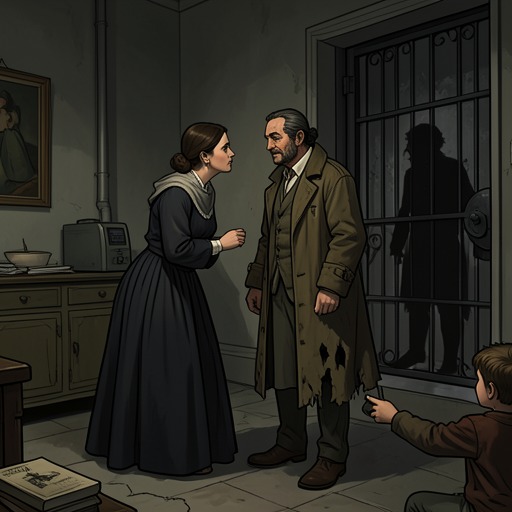
During their meeting, Pasquino plucks a sage leaf and rubs it against his teeth and gums, believing it will clean away what remains after eating. He soon changes countenance, loses his sight and speech, and dies. Simona weeps and cries out for help. Stramba and Lagina hurry over; seeing Pasquino swollen and marked with dark spots, Stramba accuses Simona of poisoning him. Neighbors hear the commotion and gather. Grief leaves Simona unable to defend herself effectively, and the people present accept Stramba’s accusation as true.
Simona is taken to the Provost’s palace. Stramba and two other companions of Pasquino, Atticciato and Malagevole, press the charge, but the judge cannot discover that she acted maliciously or is otherwise guilty. He therefore goes with her to examine Pasquino’s body and the place where he died, seeking to understand the circumstances more clearly than her distressed account has allowed him to do. The inquiry sets Simona’s grief against the crowd’s certainty: those who accuse her have a ready explanation, while the judge is still trying to establish what happened.
The Demonstration and the Ending
At the garden, Simona recounts the meeting and demonstrates Pasquino’s action, rubbing a sage leaf against her own teeth. Stramba, Atticciato, and the others ridicule her explanation as foolish and renew their demand that she be punished by fire. As she stands confounded by grief for Pasquino and fear of the punishment being demanded, Simona suffers the same sudden collapse as her lover and dies. Her attempt to make the event intelligible thus becomes its repetition: she reproduces the gesture that preceded Pasquino’s death, and the repeated gesture supplies an answer only through taking her life.
The judge and those present are astonished and remain silent. The judge proposes that the sage has become poisonous, although he observes that sage is not ordinarily so, and orders the bush cut down to its roots and burned so that it cannot harm anyone else. When the gardener levels it, a remarkably large toad is found beneath it. Those present conclude that its pestilential breath had made the sage venomous; the toad and the cuttings are burned together within a barrier of brushwood. The account gives this as the explanation reached by the witnesses, closing the inquiry with a discovery rather than with a confession or conviction.
The narration presents Simona’s death as an escape from the calumny of men whose accusation might otherwise have determined her fate. She and Pasquino are buried together in the church of St. Paul by Stramba and the other companions who had accused her. Emilia’s framing links Simona’s garden death with the earlier story of Andrevuola, while stressing a difference: unlike Andrevuola, Simona is not released from the court through fortitude or constancy, but through an unexpected death. Her story’s tragic symmetry—one lover dies from the sage, the other dies repeating his act—turns a small domestic explanation into the decisive proof that the accusation against her was unjust.